AI in your existing software, without rebuilding everything
Your systems run, your people know them and the data lives in them. AI does not have to replace that. We build it alongside and connect it to what you already have, so the work gets faster without adding yet another package.
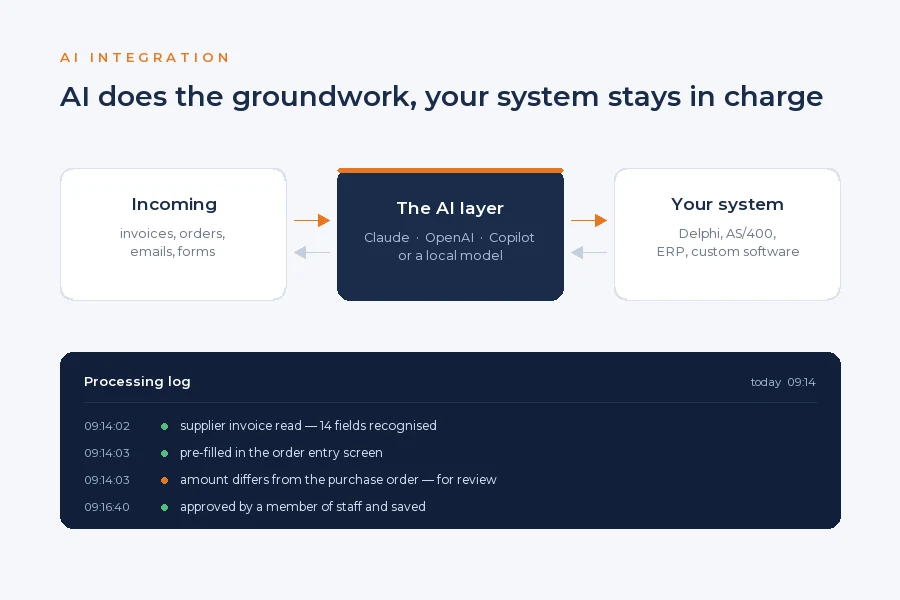
AI only pays off in the system where the work happens
A separate chat app next to the work mostly leads to copying and pasting. The gain is where your people already work: the order screen, the case file, the mailbox. That is where AI needs to be able to read data and enter it.
That is integration work, and we have been doing it for years, including with software that is twenty years old, such as Delphi applications and the AS/400. Your system stays in charge; the AI does the groundwork.
Get in touch →Where AI saves time in practice
It almost always starts with one recurring task that takes a lot of time. That is the one we tackle first.
Processing documents
Reading invoices, orders and forms automatically and placing them pre-filled in the entry screen you already use, instead of retyping them.
Questions to your own documents
Making manuals, procedures and contracts searchable in plain language. The answer comes from your own sources, with a reference to the document.
Chatbots on your own knowledge
An assistant for staff or customers that answers from your own information and data, not from whatever happens to be on the internet.
Sorting and summarising
Automatically classifying and summarising incoming emails, tickets and reports, and routing them to the right person or department.
Translation in the process
Translating texts automatically the moment they are entered in your system, so multilingual content is no longer a separate project.
Tailored models
Where a general model falls short, tuning or training a model on your own data and field.
Start small, measure, then expand
No big AI programme up front, but one process where it is clear within a few weeks whether it works.
Choose one process
Which task currently takes the most time or goes wrong most often? That is where we start, and we agree up front how we will measure whether it improves.
Trial on real data
We test with your own documents and choose the model that fits best: Claude, OpenAI, Copilot or a local model.
Build it into your system
The AI is connected to the software you already use. Where needed, a member of staff approves the result before it is saved.
Monitor and adjust
Models and prices change quickly. We keep track of what is processed, what it costs and whether another model now fits better.
You decide where your data goes
We are not tied to one vendor. For each application we choose what suits the sensitivity of the data.
Business AI services
Claude, OpenAI or Microsoft Copilot on business terms, under which your data is not used to train their models.
Local models
For sensitive data the model runs on your own server or in your own environment. Nothing then goes to an external service.
Agreements on paper
What is processed, where and by whom is recorded in a data processing agreement, so it fits within the GDPR.
AI that is already running in production
Christmas Guide, our own platform for Christmas markets and events across Europe, is published in five languages. As soon as an organiser posts an event, AI translates it automatically into the other languages. The translation is built into the platform itself, with no manual work in between.
With Apptimate Academy we teach others to build their own apps with AI, even without programming experience. And in our own development work we use AI every day, including for maintaining Delphi applications.
What you do not need to call us for
We do not have AI write marketing copy, blogs or social media posts, and we do not run AI strategy programmes without a concrete process to tackle. We build working solutions into your existing processes.
AI is one part of what we do
An AI application rarely stands alone: often something also needs to happen to an integration, a database or the system itself. We do that work too, so you do not need to bring in a second supplier.
See all our services →Frequently asked questions
Does our software have to be replaced?
No. We connect AI to the software you already have, through an API, the database or an intermediate layer. That also works with older systems such as Delphi applications or an AS/400. Your system stays in charge; the AI supplies the groundwork.
Where does our data go?
You decide. We work with business services from Claude, OpenAI and Microsoft Copilot, under which your data is not used to train models. For sensitive data a local model can run on your own server, so nothing leaves your environment.
Can it work without a cloud service?
Yes. A local model runs on your own hardware or in your own environment. It is sometimes slightly less capable than the largest cloud services, but for tasks such as reading, classifying and summarising documents it is often more than enough.
What if the AI makes a mistake?
We plan for that up front. Where a mistake has consequences, a member of staff approves the result before it is saved. Doubtful cases are set aside and reported, and everything is logged, so you can see afterwards what the AI did.
Which AI model do you use?
That depends on the task. We work with Claude, OpenAI, Microsoft Copilot and local models, and choose per application on quality, cost and where the data is allowed to go. Because we are not tied to one vendor, the model can be swapped later.
How long does a trial take?
Usually a few weeks. We choose one process, test with your own data and measure whether it saves time or prevents errors. Then you know whether expanding is worthwhile, before a larger project begins.
