Two-factor authentication that does not get in the way
A password on its own has not been enough for years. But a second factor that is too much hassle gets worked around — with a sticky note, a shared account, or an exception nobody ever reverses. We roll out 2FA and MFA in a way that holds up.
The technology is the smallest part
Switching on a second factor is an afternoon of work. The real work starts with the exceptions: the colleague without a work phone, the external party who also needs access, the service accounts with no human behind them, and the Friday afternoon when somebody leaves their phone on the train.
Fail to settle those cases up front and within a month you have exceptions that hollow out the protection again. We have run this often enough to know which questions belong first.
Get in touch →From choosing to running it
You can bring us in for the whole route, or only for the part you are stuck on.
Advice and choice
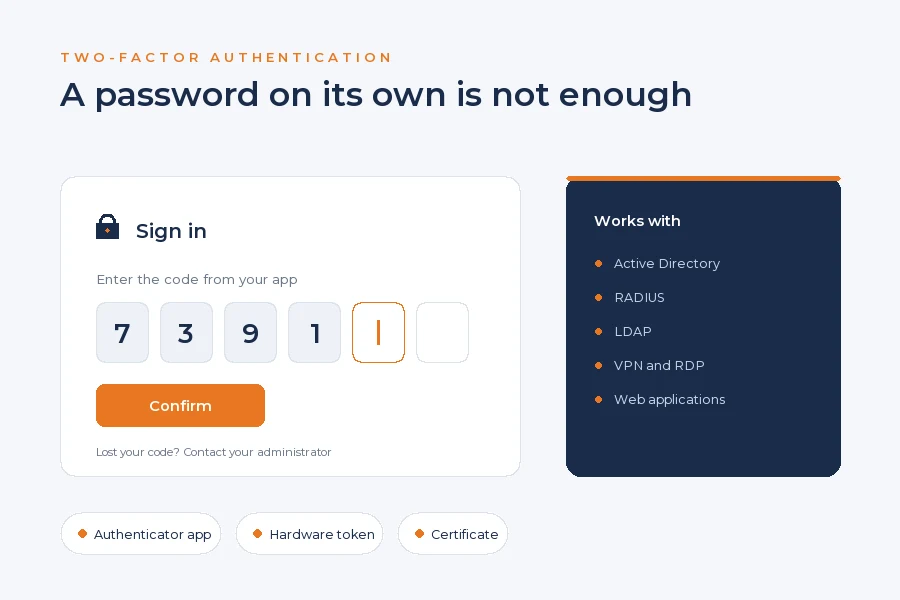
Which form suits which group? An authenticator app for the office, a hardware token for people who cannot bring a phone in, a certificate for machines. Usually it is a combination.
Connecting to your environment
Hooking into Active Directory, RADIUS and LDAP, so the same second factor covers the VPN, the RDP session and your web applications — rather than being arranged separately per system.
Rollout and enrolment
Enrolling users at a pace the service desk can absorb, with clear instructions and a fallback for anyone who gets stuck.
Certificates and PKI
Issuing and managing certificates for secured communication between systems and parties, including keeping an eye on expiry dates.
Key management
For heavier requirements: key management through a key management service or an HSM, plus advice on what is proportionate in your situation.
Running it afterwards
Lost tokens, people joining and leaving, recovery procedures that actually work. This is where rollouts come apart in the long run.

Ten years on the build side of authentication
We spent ten years leading development and support at a vendor of authentication solutions: design on Windows and Linux servers, integration with Active Directory, RADIUS and LDAP, and implementations at national and international organisations. Since then we have done that work as consultants.
On top of that, we have managed and issued PKI certificates for secured communication at a regulator, connected a key management service to a back-end system, and assessed whether an HSM as a service was worth taking on.
Security is not a standalone product
Two-factor authentication stands or falls with the rest: who looks after the servers, how is the backup arranged, and what happens if somebody gets in anyway? We do that work too, so we can look at it as a whole rather than bolting one measure on top.
See all our services →Frequently asked questions
What is the difference between 2FA and MFA?
2FA is two-factor authentication: exactly one extra factor is added to the password, for instance a code from an app. MFA means multiple factors and is the broader term. In practice people use them interchangeably; what matters is which factors you choose, and for whom.
Is SMS still safe as a second factor?
SMS is better than a password alone, but it is the weakest of the common methods: messages can be intercepted and a phone number can be moved to another SIM card. For accounts that really matter we recommend an authenticator app or a hardware token.
Does two-factor authentication also work for VPN and RDP?
Yes. By connecting to Active Directory, RADIUS and LDAP, the same second factor applies to the VPN connection, the RDP session and your web applications. That is exactly why it is worth arranging centrally rather than per system.
How do you handle 2FA for service accounts with no person behind them?
Not with an app on a phone. For machines and interfaces you use certificates or keys instead of a second factor someone has to type. These are the accounts forgotten during a rollout, and the exception that follows is never rolled back.
What happens if someone loses their phone?
Then a recovery procedure has to be ready that works and is not itself a hole in your security. Who may re-register someone, how do you establish it really is that colleague, and how fast can it happen on a Friday afternoon? We arrange that in advance.
Does NIS2 require two-factor authentication?
NIS2 does not prescribe a specific technology, but it does require appropriate measures for access control, and multi-factor authentication is named as an obvious one. How the directive is implemented differs per country; whether your organisation falls under it depends on sector and size.
